
Missing teeth can affect more than your smile. They can change the way you chew, speak, and feel about your appearance. They may also affect the position of nearby teeth and the way your bite comes together. For many patients, dentures are a practical and effective way to replace missing teeth and restore daily function.
If you are considering a dentures service in Langley, it helps to understand the difference between complete dentures and partial dentures. Both options are removable dental prostheses, but they are used in different situations. The right choice depends on how many teeth are missing, the condition of your remaining teeth, your jaw and gum health, and your long-term oral health goals.
What Are Dentures?
Dentures are removable appliances designed to replace missing teeth and surrounding oral tissues. They are custom-made to fit your mouth and support chewing, speech, facial appearance, and smile aesthetics.
Dentures may be used when teeth have been lost due to dental decay, periodontal disease, trauma, tooth wear, or other oral health concerns. A dentist in Langley BC can examine your mouth, review your health history, and recommend whether complete dentures, partial dentures, implant-supported dentures, or another tooth replacement option may be suitable.
The Canadian Dental Association explains that complete and partial dentures both need daily cleaning, similar to natural teeth, because plaque and tartar can build up on dentures and may contribute to stains, bad breath, gum problems, cavities, or gum disease around remaining teeth.
What Are Complete Dentures?
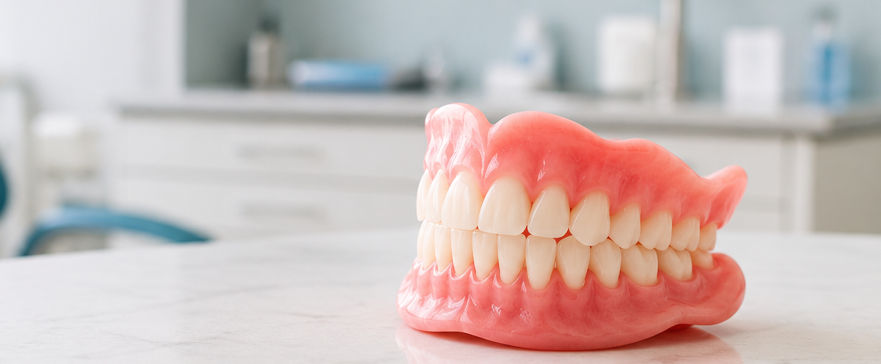
Complete dentures, sometimes called full dentures, are used when all natural teeth are missing in the upper jaw, lower jaw, or both. They replace a full arch of teeth and are usually made with acrylic resin teeth attached to a gum-coloured base.
Complete dentures are supported by the gums and underlying bone. Upper complete dentures often cover the palate, while lower complete dentures are shaped to fit around the tongue. Because the lower jaw has less surface area for suction, some patients find lower dentures more challenging to adapt to.
Complete dentures may be recommended when remaining teeth cannot be restored or when a patient is already fully edentulous, meaning all teeth are missing in one or both arches.
Types of Complete Dentures
There are two common types of complete dentures: conventional dentures and immediate dentures.
Conventional dentures are made after teeth have been removed and the gums and jaw tissues have healed. This healing period allows the denture to be made after the tissues have stabilized, which can help improve fit.
Immediate dentures are made before teeth are removed and placed shortly after extractions. The benefit is that the patient does not have to be without teeth during the healing period. However, gums and bone can shrink during healing, so immediate dentures often require adjustments, relining, or replacement later. The Canadian Dental Association notes that healing after extractions can take up to six months and that immediate dentures may need to be relined for a proper fit.
What Are Partial Dentures?
Partial dentures are used when one or more natural teeth remain in the mouth. They replace missing teeth while using nearby natural teeth, gums, and oral tissues for support.
A removable partial denture usually includes artificial teeth attached to a gum-coloured base. It may also include metal or acrylic clasps that fit around selected natural teeth to help hold the denture in place. Partial dentures can be removed for cleaning and while sleeping.
Partial dentures may be recommended when several teeth are missing, when neighbouring teeth are not strong enough to support a bridge, or when dental implants are not the preferred option. The Canadian Dental Association describes partial dentures as removable prostheses that may be used when nearby teeth are not strong enough to hold a bridge or when more than a few teeth are missing.
Complete Dentures vs Partial Dentures: Main Differences
The biggest difference is the number of missing teeth they replace.
Complete dentures replace all teeth in an upper or lower arch. Partial dentures replace some missing teeth while keeping natural teeth in place.
Complete dentures rely mainly on the gums, jawbone, suction, and muscle control for support. Partial dentures often gain additional stability from remaining natural teeth.
Complete dentures may require more adaptation, especially with chewing and speech. Partial dentures may feel more stable for some patients because they can use existing teeth for support.
A Langley dental office can help determine which type of denture fits your clinical needs and lifestyle.
When Might Complete Dentures Be Recommended?
Complete dentures may be suitable if all teeth are missing or if remaining teeth have a poor prognosis due to advanced decay, severe periodontal disease, mobility, or extensive structural damage.
They may also be considered when a patient wants a removable, non-surgical tooth replacement option. Complete dentures can restore the appearance of a full smile and help improve basic chewing function, although they may not feel exactly like natural teeth.
Some patients later choose implant-supported dentures for improved stability, especially in the lower jaw. Implant-supported overdentures attach to dental implants and may reduce denture movement during speaking or eating.
When Might Partial Dentures Be Recommended?
Partial dentures may be suitable if you still have some healthy natural teeth. They can fill gaps left by missing teeth, improve chewing, support facial appearance, and reduce unwanted movement of nearby teeth.
Leaving gaps untreated can allow adjacent teeth to drift or tilt into empty spaces. This can affect bite alignment and make cleaning more difficult. Partial dentures help maintain tooth spacing and restore a more balanced bite.
Partial dentures are often used when dental bridges or implants are not ideal due to bone levels, cost, medical factors, or personal preference.
What Is the Denture Process Like?
The denture process usually begins with a dental examination. Your dentist will assess your gums, bone levels, remaining teeth, bite, jaw relationship, and oral tissues. X-rays may be taken if needed.
Next, impressions or digital scans may be used to create models of your mouth. Measurements are taken to help design the denture’s shape, bite, and tooth position. You may have a try-in appointment to check appearance, comfort, and bite before the final denture is made.
Once the denture is delivered, adjustments are common. New dentures can cause sore spots at first as the mouth adapts. Follow-up visits allow your dental team to refine the fit and improve comfort.
Will Dentures Feel Like Natural Teeth?
Dentures can restore important function, but they do not feel exactly the same as natural teeth. It may take time to learn how to speak and chew comfortably with them.
At first, you may notice increased saliva, mild soreness, or a feeling that the denture is bulky. These symptoms usually improve as your oral muscles adapt. Starting with softer foods, chewing evenly on both sides, and practicing speech can help.
If dentures slip, pinch, create persistent sore spots, or affect your bite, they should be adjusted by a dental professional. Do not try to adjust or repair dentures at home, as this can damage the appliance or injure your mouth.
How to Care for Complete and Partial Dentures
Good denture care is essential for oral health. Dentures should be cleaned every day to remove food particles, plaque, and bacteria. The Canadian Dental Association recommends removing dentures, rinsing away loose food particles, and brushing all surfaces with a denture brush or soft-bristle toothbrush using denture cleaner or mild soap. Regular toothpaste and household cleaners may be too abrasive for dentures.
Dentures should usually be removed at night to give the gums a rest. The Canadian Dental Association recommends taking dentures out every night, cleaning the gums, and soaking dentures overnight in a denture cleanser, warm water, or a half-and-half mix of warm water and vinegar; dentures with metal clasps should be soaked in warm water only.
Patients with partial dentures should also brush and floss their remaining natural teeth daily. This helps reduce the risk of cavities and gum disease around the teeth that help support the denture.
When Should You Replace or Adjust Dentures?
Dentures may need adjustment over time because the gums and jawbone naturally change shape. A denture that once fit well may begin to feel loose, cause sore spots, or affect chewing.
You should schedule an appointment if your denture feels unstable, causes pain, clicks while speaking, creates mouth sores, or changes your bite. Regular dental visits are also important for checking oral tissues, denture fit, and remaining teeth.
Final Thoughts
Complete and partial dentures can both help replace missing teeth, improve appearance, and support everyday function. Complete dentures are used when all teeth are missing in an arch, while partial dentures are used when some healthy natural teeth remain.
The best option depends on your oral health, comfort, remaining teeth, bone support, and treatment goals. If you are exploring a dentures service in Langley, a dental examination can help you understand your options and choose a treatment plan that supports your long-term oral health.
At Langley Dental Centre, patients can receive personalized guidance for missing teeth, denture care, and restorative treatment options in a comfortable and supportive environment.